Dear Colleagues,
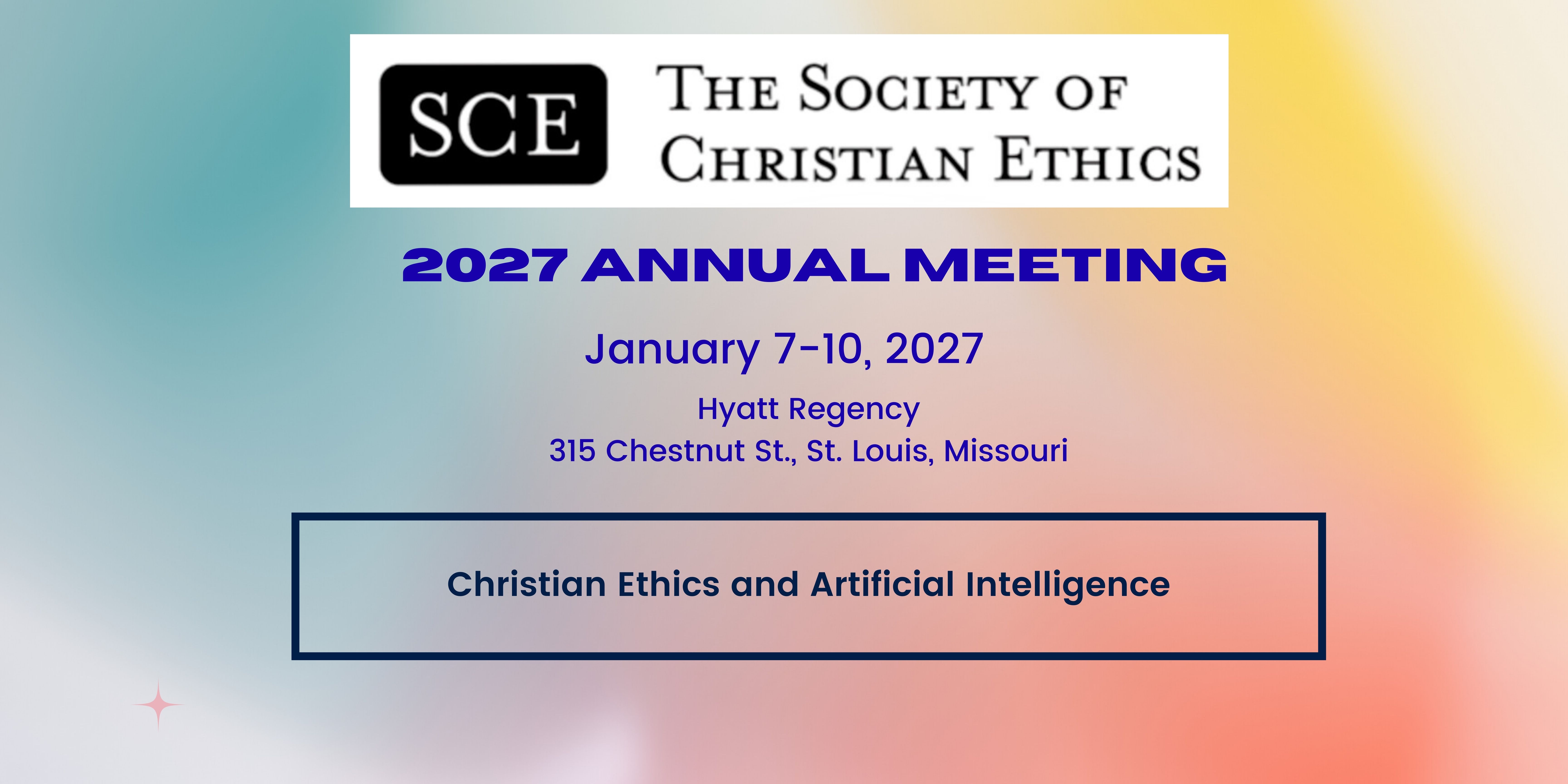
I am pleased to announce the conference theme for the 2027 Annual Meeting of the Society of Christian Ethics in St. Louis, Missouri: Christian Ethics and AI
Artificial intelligence systems increasingly influence how we think, where our attention is focused, and what we care about. They inform choices that we make and decisions that are made for us. Often operating as invisible infrastructure, these systems now permeate multiple sectors of society, including education, finance, technology, healthcare, government, media, and religion. They affect where power is concentrated and how social benefits, risks, and burdens are distributed. Each day, we confront ethical questions raised by AI—through newsfeeds that are themselves filtered by AI.
For the 2027 Annual Meeting, I invite scholars to show the relevance of Christian ethics in an age of AI-curated information environments and expanding algorithmic capacity. How might our scholarship strengthen public discourse and guide decision-making regarding AI systems and their deployment—for instance, by clarifying relevant norms, fostering discernment, bringing attention to underrepresented voices, showing the wisdom of historical religious traditions, engaging religious communities, or informing law and public policy? Possible topics at the intersection of AI and Christian ethics include (but are not limited to):
Social and applied ethics: differential access to AI systems and services; bias and discrimination in training data; data privacy and surveillance; unconsented reuse of scholarly work; data-center energy and resource burdens; environmental sustainability; job displacement; bioethics and healthcare applications; AI-enabled weapons systems.
Moral anthropology and ethical formation: influences of “chatbot” friends, lovers, and clergy on persons and communities; impact of recommendation engines on the formation of desire; uses of AI decision tools and their implications for the development of prudence or practical wisdom.
Metaethics and fundamental moral theology: whether an AI system could ever constitute a moral agent or a religious subject; whether it could, in principle, have a conscious, interior life or a morally relevant experience; whether its computational outputs could ever count as true moral judgments with corresponding authority.
The possibilities are limited only by our imagination. AI is a fast-moving stream, and few of us may feel fully competent to address its emerging capabilities. Yet here we are, standing in the stream, already subject to its currents. How shall we respond as Christian ethicists?
Sincerely,
Diana Fritz Cates
President, Society of Christian Ethics
Submitting Proposals
All proposals are due Friday March 20, 2026. Proposals that are submitted after that date will not be eligible for the summer 2026 or January 2027 meetings. Proposals will be accepted only from members whose SCE dues have been paid. All the relevant policies governing proposals for papers, panels, and posters are summarized in the document “Submission Guidelines” which is available on the SCE website. Working Groups submit their proposals here, even though they are guaranteed a concurrent session slot.
Submit your concurrent session proposals here.
Poster Sessions
Posters that include syllabi or content for teaching and learning Christian Ethics, as well as those that include teaching Christian Ethics in non-traditional contexts, are most welcome. If your proposal is selected for this year's meeting, it will not affect your eligibility to submit paper or poster proposals for future meetings. Finally, many universities and colleges provide institutional support for those who are listed in the program as presenters, including those of poster sessions.
Submit your poster proposals here.
Interest Groups Slots
Interest Groups normally meet during early morning or evening time slots, and proposals must be made by the group's convener(s) in order to be considered. Each IG may submit one (1) proposal for an early morning or evening time slot. Interest Group requests for evening sessions are exempt from competitive review and are accepted on a space-available basis.
Submit your Interest Group proposal here.
Conversation with an Author
Any member of the SCE who has a book published between January 1, 2025 and April 30, 2026 is eligible to submit his or her own book for the Conversation with an Author session. Revised or subsequent versions of a book are not eligible. Authors are responsible for ensuring that facilitators have a copy of the book. Please note that space is limited and will be assigned on a first come, first served basis .
Submit for the Conversation with an Author session here.
Summer Meeting (Aug. 11-13)
For the second year in a row, papers presented at the summer meeting will also be eligible for peer review for the JSCE. This opportunity is being offered as one way to increase access for presentation and publication in the JSCE to our members who may find it difficult to travel to the Annual Meeting in person in January. Members who elect to present in August will have their papers reviewed in August, and considered for publication alongside the papers from the Annual Meeting in January.
With this Call for Proposals, the portal is open for submissions to both the summer meeting and the Annual Meeting in January 2027. When you submit your abstract, you will be prompted to indicate if you wish to present virtually at the Summer Meeting (Aug. 11-13), in person at the Annual Meeting (Jan. 7-10), or either. All submissions will be blind-reviewed at the same time and evaluators will have no knowledge of which meeting venue has been requested.
Call for Nominations:
Vice President and Board of Directors
The SCE Nominating Committee is collecting a broad and diverse pool of qualified candidates to consider as potential nominees for the 2027 open Board positions. We are inviting you as members to submit nominees for consideration for the following positions.
- Vice President (four-year term as a part of the Presidential line of succession)
- Board Member (four-year term)
- Board Member - Student (two-year term)
Please use the the online call for nominations form to submit your nomination(s). You will be able to submit the form more than once. Self-nominations are also permitted.
Deadline for submissions: Monday, February 16, 2026.
*Please note this form is behind the member wall so you will be required to login.
Lifetime Achievement Award
March 20, 2026 is also the deadline for proposing names to the Lifetime Achievement Award Committee. Click here for more information about the selection committee and the submission process. Send nominations to Rebecca Todd Peters who chairs the committee as past president of the SCE, [email protected].
Nominations for International and Global Scholars
The International Scholarly Relations Committee (ISRC) seeks to strengthen ties between the SCE and scholars and their institutions from around the world.
- Two subsidy scholarships are available for international scholars to attend the 2026 annual meeting that include a waiver of the registration fee as well as a $500 stipend to offset the cost of attending the annual meeting. Applications are due Monday, August 3, 2026.
Bring a Global Scholar to the SCE Annual Meeting. The Global Scholar receives a waiver of the registration fee, expenses up to $4000, and a guaranteed concurrent session slot. SCE members are invited to nominate scholars from around the world, notably the Global South, to be SCE Global Scholars. Click here for additional information.
Society of Christian Ethics Book Prize:
The Society of Christian Ethics (SCE) announces a new award category of Book Prizes. We are seeking to recognize books with significant contributions in the field of Christian ethics. Submissions will open in early 2026 with prizes awarded at the 2027 SCE Annual Meeting. Click here for more information.
Meeting Location: The 2027 annual meeting of the Society of Christian Ethics will be held January 7-10, 2027 at the Hyatt Regency, 315 Chestnut St, St. Louis, Missouri. Phone number: 314-655-1234.